
Vacuum Leak – Causes, Symptoms & Diagnosis
A vacuum leak occurs when unmetered air enters the intake system, often after the MAF sensor has already measured the incoming airflow. This can cause the engine to run lean and disrupt the air-fuel mixture, leading to rough idle, hesitation, stalling and poor acceleration. This guide explains the most common vacuum leak sources and how to diagnose them systematically.
Symptoms of a Vacuum Leak
- Rough or unstable idle
- Hesitation during acceleration
- Engine runs lean
- High or fluctuating RPM at idle
- Whistling or hissing noise from the engine bay
- Check Engine Light with lean-related fault codes
Main Causes
- Cracked or disconnected vacuum hoses
- Leaking PCV valve or PCV hoses
- Intake manifold gasket leak
- Throttle body gasket leak
- Brake booster hose leak
- Leaking EVAP purge valve or lines
- Cracked intake boot or air duct
How a Vacuum Leak Creates a Lean Condition
A vacuum leak allows unmetered air to enter the intake system after the MAF sensor. The ECU does not initially account for this extra air, so the oxygen sensors detect a lean mixture and fuel trims increase as the ECU adds fuel to compensate.
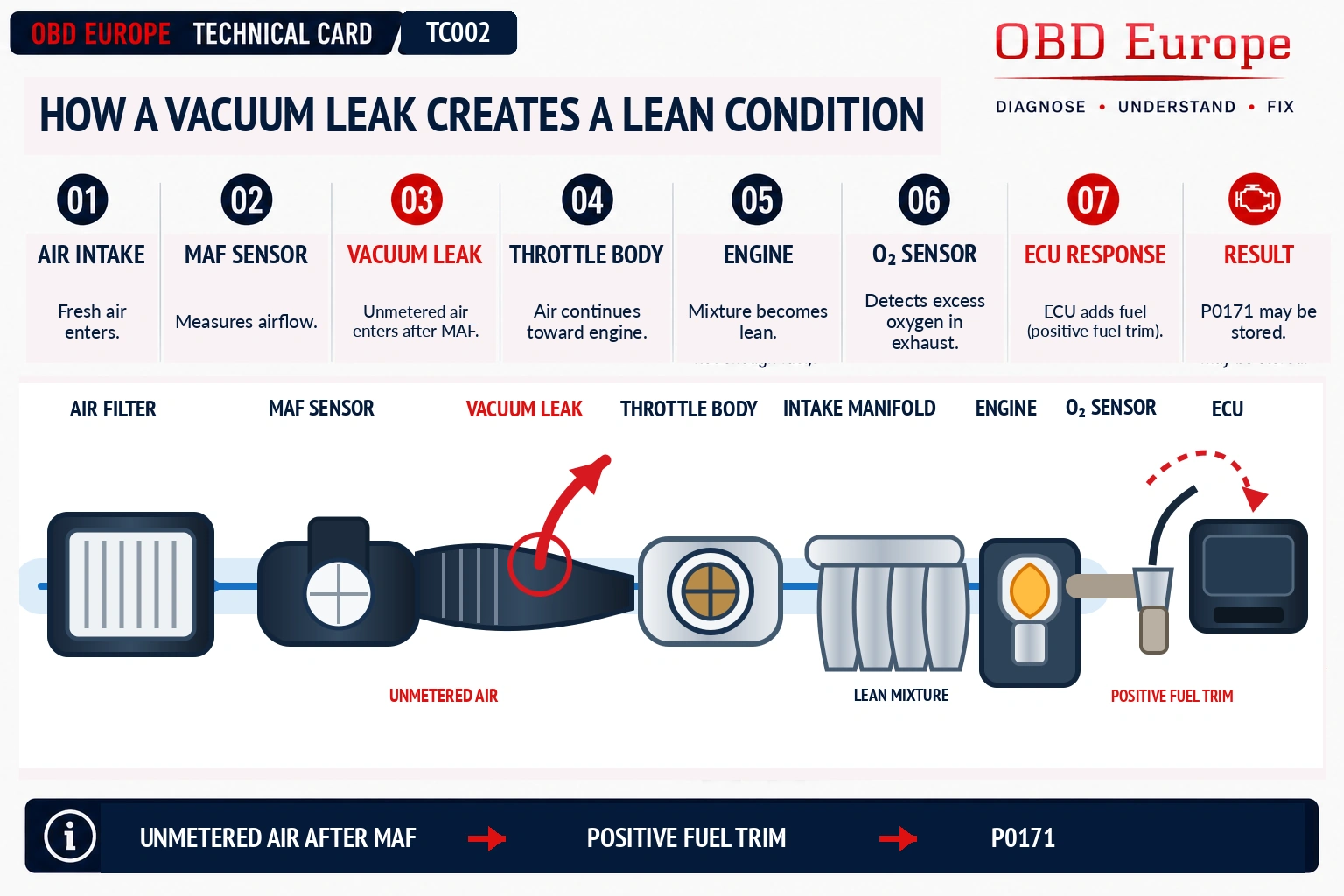
If positive fuel trims are significantly higher at idle and improve as engine speed increases, inspect carefully for vacuum or intake leaks. A smoke test can help locate small leaks that are difficult to find visually.
Step-by-Step Diagnosis
1. Scan for Lean and Airflow Codes
Use an OBD2 scanner to check for lean and airflow-related fault codes. Codes such as P0171 and P0174 can indicate that the ECU is adding fuel to compensate for excess unmetered air.
2. Check Fuel Trim Data
Check Short-Term Fuel Trim (STFT) and Long-Term Fuel Trim (LTFT) in live data. A vacuum leak commonly causes positive fuel trims because the ECU adds fuel to compensate for air entering the intake system without being measured correctly.
Compare fuel trims at idle and at approximately 2,500 rpm:
- Fuel trims that are strongly positive at idle but improve as RPM increases can point toward a vacuum or intake leak
- High positive trims at both idle and higher RPM may indicate another air-measurement or fuel-delivery problem
- A significant difference between banks can help narrow the problem to one side of the engine
3. Listen for Hissing Sounds
A vacuum leak can produce a noticeable hissing or whistling noise. Listen carefully around:
- Intake manifold
- Vacuum hoses
- Throttle body
- PCV system
- Brake booster hose
4. Inspect Vacuum Hoses and Intake Ducts
Look carefully for:
- Cracks or splits
- Loose connections
- Collapsed hoses
- Disconnected vacuum lines
- Cracks in the intake boot or ducting
Pay particular attention to leaks after the MAF sensor, because air entering here may not be included in the ECU’s airflow calculation.
5. Check the PCV System
A damaged PCV valve, diaphragm or hose can create a significant vacuum leak. Inspect the complete PCV system before replacing components based only on symptoms or fault codes.
6. Inspect Intake and Throttle Body Gaskets
Leaks around the intake manifold or throttle body can allow unmetered air into the engine. Depending on the engine design, an intake manifold gasket leak may affect one bank more than the other.
7. Perform a Smoke Test
A smoke test is one of the most effective methods for locating small or hidden intake leaks. Introduce smoke into the intake system using appropriate diagnostic equipment and inspect for smoke escaping from hoses, seals, gaskets and connections.
8. Verify the Repair with Live Data
After repairing the leak, monitor fuel trims again. If the vacuum leak was the cause, positive fuel trim correction should decrease as the ECU no longer needs to compensate for the unmetered air.
Relevant Fault Codes
- P0171 – System Too Lean (Bank 1)
- P0174 – System Too Lean (Bank 2)
- P0101 – MAF Sensor Performance
- P0505 – Idle Control System Malfunction
- P2195 – O2 Sensor Signal Stuck Lean
What Scanner Do You Need to Diagnose a Vacuum Leak?
To diagnose a vacuum leak accurately, use an OBD2 scanner that can display Short-Term Fuel Trim and Long-Term Fuel Trim alongside other relevant live data.
Comparing fuel trims at idle and at higher RPM can help distinguish an intake or vacuum leak from fuel-delivery or airflow-measurement problems. The scanner helps narrow down the fault, while the physical leak itself is usually confirmed by inspection or a smoke test.
When to Seek Professional Help
- The vacuum leak cannot be located visually
- Fuel trims remain strongly positive after obvious leaks have been repaired
- The engine stalls or runs extremely poorly
- Multiple lean-related fault codes continue to return
- A smoke test or further intake-system testing is required