
Bidirectional Tests Explained – What Active Tests Can Diagnose
Bidirectional tests allow a diagnostic scanner to do more than read information. The scan tool can send a command to a supported control module and request an actuator, output or system to perform a specific action.
This makes active testing one of the most useful advanced diagnostic functions because it helps separate a failed component from a wiring, power-supply, control-module or input problem.
What Is a Bidirectional Test?
With normal diagnostics, information flows mainly from the vehicle to the scan tool. With bidirectional diagnostics, the scan tool can also send supported commands back to the vehicle.
Examples may include commanding:
- Radiator cooling fans
- EVAP purge or vent valves
- Fuel pumps
- Relays
- Solenoids
- Lights and body outputs
- Door locks
- ABS pump or valves during supported service procedures
- Other manufacturer-specific actuators
Available tests vary greatly by vehicle, control unit and scan tool.
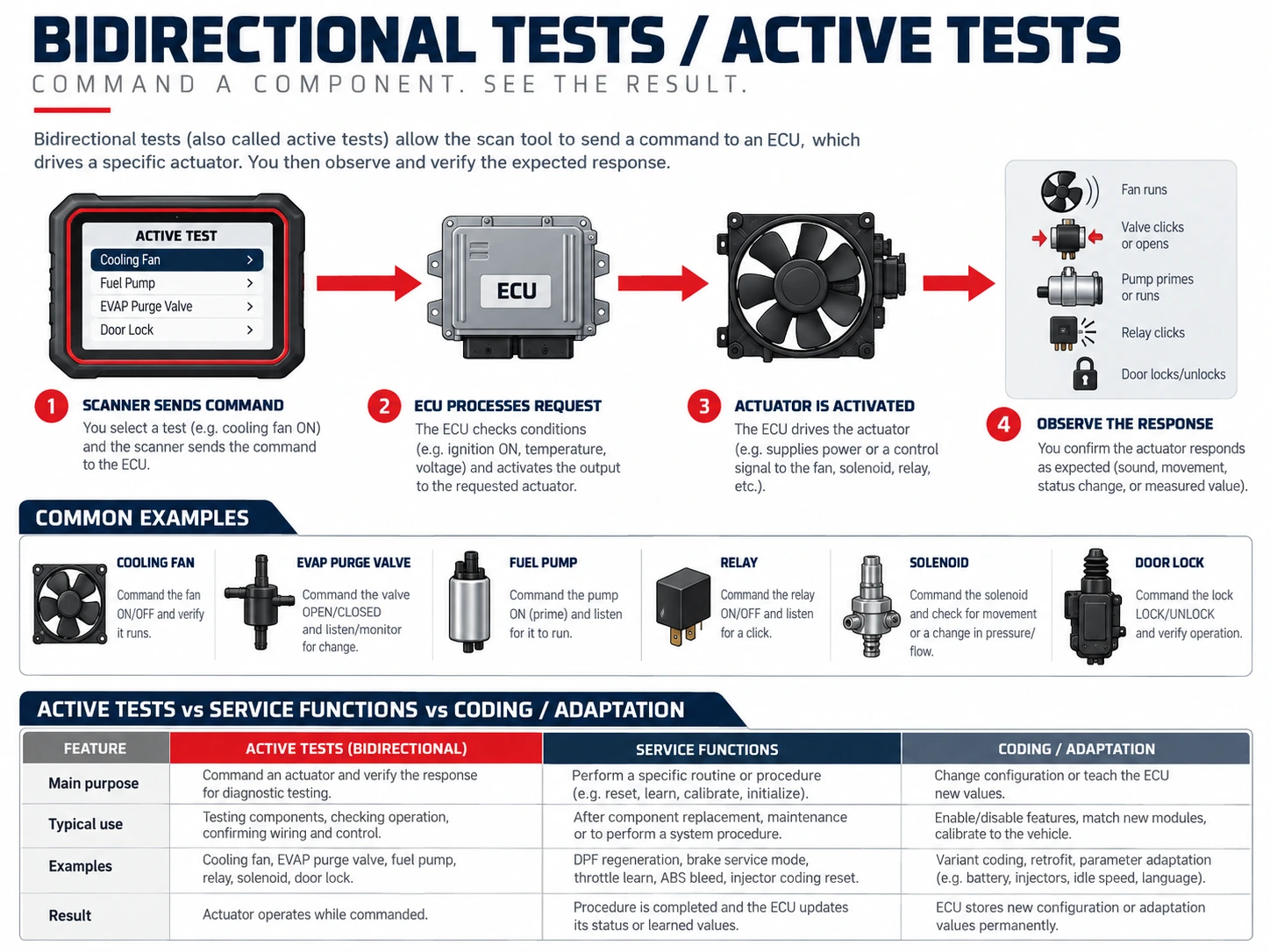
Active Tests vs Generic OBD2
Standard OBD includes a diagnostic service for requesting control of supported onboard systems, tests or components. In real workshop use, however, the broad bidirectional functions people expect from a professional scanner are usually delivered through manufacturer-specific or enhanced diagnostic communication.
This is why a basic OBD2 code reader may support fault codes and live data but offer no useful actuator tests for a particular vehicle.
Why Bidirectional Tests Are Useful
An active test can help answer a simple question: can the control module command this component and does the component respond?
That can narrow a fault much faster than replacing parts based only on a code.
Example: Cooling Fan Test
If the engine cooling fan does not operate when expected, a bidirectional scanner may allow the technician to command the fan on.
If the fan runs when commanded, the fan motor, power circuit and at least part of the control path are capable of working. Diagnosis can then move toward temperature inputs, control logic or the conditions that normally request fan operation.
If the fan does not run when commanded, the test plan moves toward power supply, ground, relay or module output, wiring and the fan itself.
Example: EVAP Purge Valve Test
A supported active test can command the purge valve while the technician observes engine response, fuel trims, pressure data or the valve itself.
This can help determine whether the valve responds electrically and whether the system reacts as expected.
Example: Fuel Pump Command
On supported vehicles, commanding the fuel pump can help separate a control-side problem from a fuel-pressure or pump problem. The command should be combined with the correct electrical and pressure measurements.
Do not assume that a scan-tool command proves pressure or flow. It only proves what the test actually verifies.
How to Use an Active Test Properly
1. Read the Fault Codes and Data First
Start with stored codes, freeze-frame data and live data. Active testing should answer a specific diagnostic question, not be used randomly.
2. Confirm That the Test Is Supported
A scanner may advertise bidirectional control but support different tests on different makes, models, years and control units.
3. Understand the Expected Result
Know what should happen before starting the test. For example, if you command a fan, determine whether you expect low speed, high speed or a duty-cycle response.
4. Observe the Component and Related Data
Watch the physical response and any relevant live data. A commanded actuator may click or move without actually performing correctly under load.
5. Verify With Electrical or Mechanical Testing
Use a multimeter, pressure gauge, oscilloscope or other appropriate test when needed. Bidirectional control is part of the diagnosis, not a replacement for all other testing.
What an Active Test Can and Cannot Prove
| Active test result | What it may tell you |
|---|---|
| Component responds correctly | The actuator and control path are capable of operating under the test conditions |
| No response | Further testing is needed for power, ground, wiring, actuator and control output |
| Command changes but physical result is wrong | The actuator may move but still fail mechanically or under load |
| Test unavailable | The vehicle, module or scan tool may not support that function |
Bidirectional Tests vs Service Functions
These terms overlap but are not identical.
Bidirectional or active tests usually command an actuator or output for diagnostic purposes.
Service functions perform a defined maintenance procedure such as electronic parking brake service mode, steering-angle calibration, battery registration or oil-service reset.
A scanner can have many service functions without offering broad active-test coverage, or vice versa.
Bidirectional Tests vs Coding and Adaptation
Coding and adaptation change configuration or learned values. Active tests normally command a temporary action for diagnosis.
Do not confuse a test command with a permanent configuration change.
Safety When Using Active Tests
Active tests can move components or operate systems without the normal driver input. Use them only when you understand the test and can keep people, tools and loose objects clear of moving or hot components.
- Keep hands and tools away from fans, belts and moving parts
- Use the correct vehicle state specified for the test
- Do not perform road-dependent tests while concentrating on the scanner
- Follow manufacturer procedures for braking, steering and other safety-critical systems
Do You Need a Bidirectional Scanner?
Bidirectional control is especially valuable for workshops, advanced DIY diagnosis and technicians who need to verify components rather than only read codes.
If your work is limited to reading engine codes and basic live data, you may not need it. If you regularly diagnose electrical, emissions, body, ABS or other system faults, active tests can save substantial diagnostic time.
How to Choose a Scanner With Active Tests
Do not buy a scanner based only on the words “bidirectional control.” Check support for the exact vehicle and the control units you need.
Important questions include:
- Which vehicle makes and model years are supported?
- Which control modules allow active tests?
- Are the required tests included in the current software license?
- Does the tool also provide the live data needed to verify the result?
View Professional Diagnostic Tools →
Related Diagnostic Guides
Bidirectional Test FAQ
Is every OBD2 scanner bidirectional?
No. Many scanners can only read information and clear codes. Active-test support depends on the hardware, software, vehicle and control unit.
Does bidirectional control mean the scanner can code modules?
No. Active tests, coding, adaptation and service functions are different capabilities.
Can a bidirectional test prove a component is good?
It can show that the component responds under the test conditions, but a complete diagnosis may still require electrical, pressure, mechanical or load testing.
Are bidirectional tests manufacturer-specific?
Many of the useful active tests offered by professional scan tools rely on manufacturer-specific diagnostic functions, so coverage varies by vehicle.