
How to Read OBD2 Codes – What the Letters and Numbers Mean
An OBD2 fault code is not a diagnosis by itself. It is a structured Diagnostic Trouble Code (DTC) that identifies the system and fault category in which the vehicle detected a problem.
Understanding the code format helps you decide where to begin testing and prevents a common mistake: replacing the component named in a code description without confirming the actual cause.
What Is an OBD2 Diagnostic Trouble Code?
Diagnostic Trouble Codes are standardized under SAE J2012 and related OBD standards. The code structure allows scan tools and service information to identify faults consistently while also reserving ranges for manufacturer-specific diagnostics.
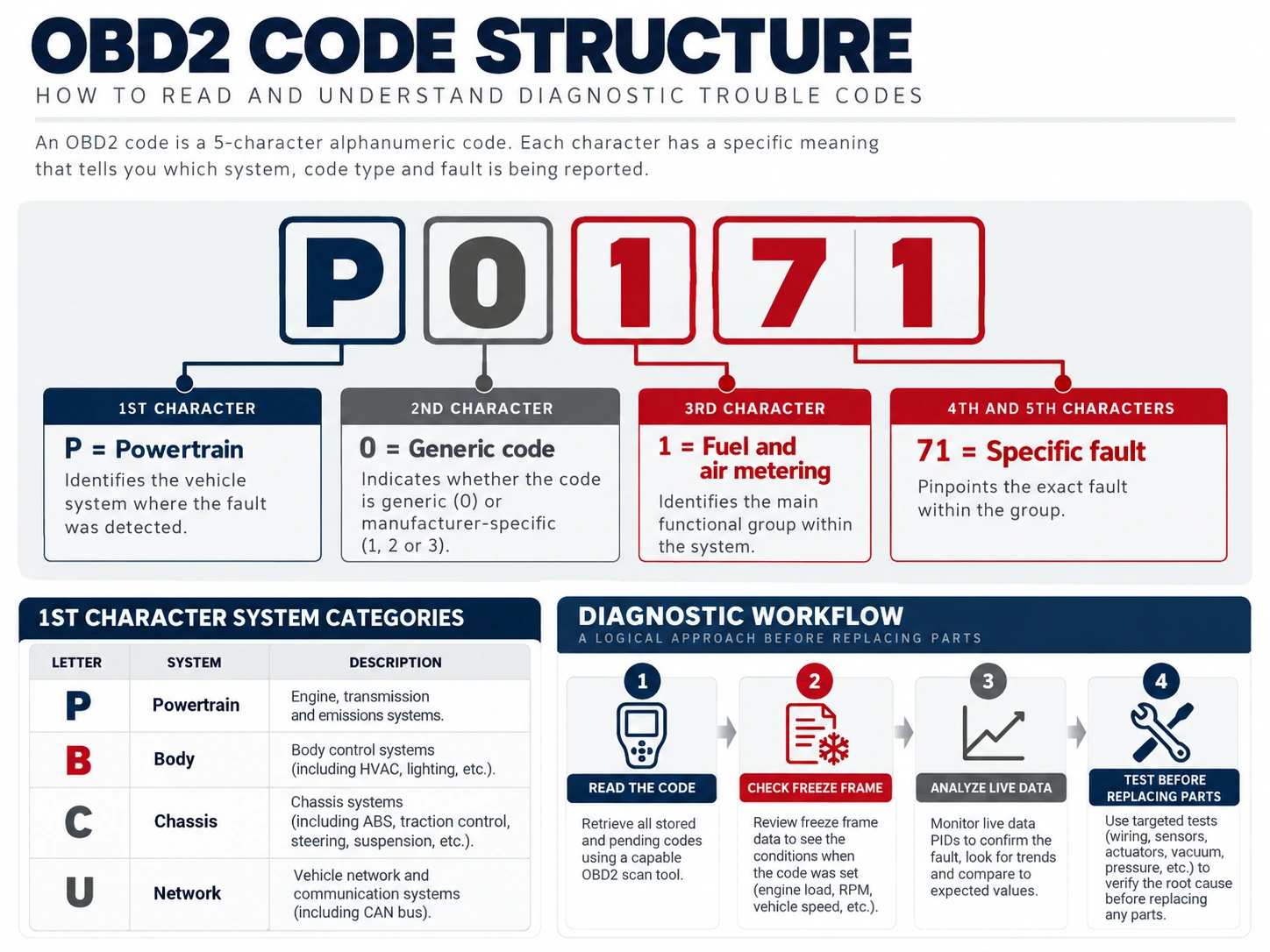
A typical five-character DTC looks like this:
P0171
What Does the First Letter Mean?
| Letter | System |
|---|---|
| P | Powertrain – engine, transmission and related emissions systems |
| B | Body – body and comfort-related systems |
| C | Chassis – chassis-related systems such as braking, steering and suspension |
| U | Network – communication between control modules |
The first letter tells you which broad vehicle system reported the fault. It does not tell you which component should be replaced.
What Does the Second Character Mean?
The second character helps identify whether the code belongs to a standardized range or a manufacturer-specific range.
For common powertrain codes, P0xxx codes are standardized generic codes and many P1xxx codes are manufacturer-specific. Additional standardized and manufacturer-specific ranges also exist, so do not decode every 2 or 3 in the second position with one oversimplified rule. Use the exact code definition for the vehicle.
This is important because two vehicles can use the same manufacturer-specific number differently.
What Do the Remaining Numbers Mean?
The remaining characters identify the fault family and the specific failure. Their exact meaning depends on the code family.
For many generic powertrain codes, the third character helps identify the subsystem, such as fuel and air metering, ignition or emissions control. The final two digits identify the specific fault within that group.
Example: How to Read P0171
- P = Powertrain
- 0 = standardized generic code range
- 1 = fuel and air metering-related group
- 71 = specific fault definition: System Too Lean, Bank 1
The code tells you that the ECU detected a lean condition on Bank 1. It does not tell you automatically whether the cause is a vacuum leak, MAF problem, low fuel pressure, injector issue, exhaust leak or sensor error.
Read the P0171 diagnostic guide →
Generic Codes vs Manufacturer-Specific Codes
Generic OBD2 codes are designed to have a common meaning across compliant vehicles. Manufacturer-specific codes allow vehicle manufacturers to report faults that are not fully covered by the generic code set.
A basic code reader may display the number but provide only a limited description for manufacturer-specific faults. A brand-specific or professional diagnostic tool can often provide more accurate code text, control-unit information and related data.
Stored, Pending and Permanent Codes
Stored Codes
A stored or confirmed DTC has met the conditions required by the vehicle’s diagnostic strategy to be recorded as a fault.
Pending Codes
A pending code indicates that a fault condition has been detected but may not yet have met the criteria to become a confirmed code. Pending codes can be extremely useful when diagnosing an intermittent problem.
Permanent Codes
Permanent emissions-related DTCs are designed so they cannot simply be erased with a scan tool. They are cleared by the vehicle only after the relevant monitor confirms that the fault has been corrected under the required operating conditions.
Why a Fault Code Is Not the Same as a Failed Part
A DTC describes what the control system detected. It does not necessarily identify the root cause.
For example, an oxygen-sensor-related code can be caused by:
- An actual sensor fault
- Wiring or connector problems
- Vacuum leaks
- Fuel-delivery problems
- Exhaust leaks
- A mixture problem that the sensor is correctly reporting
The correct diagnostic process is to use the DTC as a starting point and then verify the fault with freeze-frame data, live data and physical testing.
How to Diagnose an OBD2 Code Properly
1. Read All Codes Before Clearing Anything
Record stored, pending and permanent codes. Multiple codes can reveal whether one fault is causing several secondary symptoms.
2. Read the Freeze Frame
Freeze-frame data can show engine speed, load, temperature, speed, fuel trims and other values from around the time the fault was recorded.
Learn how to read freeze-frame data →
3. Check Live Data
Use live data to see whether the suspected system behaves abnormally now and under the conditions that triggered the code.
Learn how to read OBD2 live data →
4. Check Related Codes and Symptoms
Do not diagnose each code in isolation. A lean code, misfire code and MAF performance code may all be connected to the same underlying airflow problem.
5. Test Before Replacing Parts
Use electrical, pressure, smoke, mechanical or active tests where appropriate to confirm the fault.
Common OBD2 Code Families
- P01xx – many fuel and air metering-related faults
- P02xx – injector and fuel-related faults in many generic code ranges
- P03xx – ignition and misfire-related faults
- P04xx – auxiliary emissions controls in many generic code ranges
- P05xx – speed, idle and auxiliary input-related faults in many generic code ranges
- U-codes – communication and network faults
These are useful navigation clues, not a replacement for the exact DTC definition.
Where to Look Up an OBD2 Code
Use the exact code together with the vehicle make, model, year and engine when possible. Manufacturer-specific definitions can differ from generic descriptions.
Search the OBD2 Fault Code Library →
What Scanner Do You Need to Read OBD2 Codes?
A basic OBD2 code reader can read standardized emissions-related powertrain codes. For full-system and manufacturer-specific diagnostics, choose a tool that supports the required vehicle brand and control units.
Find the Right Diagnostic Scanner →
OBD2 Code FAQ
Can I diagnose a car from the code number alone?
No. The code identifies the detected fault condition. Use freeze frame, live data and system tests to determine the root cause.
Does a sensor code always mean the sensor is bad?
No. Wiring, power supply, vacuum leaks, fuel problems and other faults can produce a sensor-related DTC.
What is the difference between generic and manufacturer-specific codes?
Generic codes have standardized definitions across compliant vehicles. Manufacturer-specific ranges allow additional faults whose definitions depend on the vehicle manufacturer.
Should I clear the code before diagnosing?
No. Record the code and freeze-frame data first. Clearing diagnostic information can remove valuable evidence about when and how the fault occurred.