
Fuel Trims Explained – How to Read STFT and LTFT
Fuel trims show how much the engine control unit is correcting the fuel mixture while the engine runs. They are one of the most useful live-data values for diagnosing lean and rich conditions, vacuum leaks, fuel-delivery problems, MAF errors and bank-specific faults.
This guide explains what Short-Term Fuel Trim (STFT) and Long-Term Fuel Trim (LTFT) mean, how to read positive and negative values and how to compare fuel trims at idle and higher RPM to narrow down the cause of a problem.
What Are Fuel Trims?
Fuel trim is the ECU’s correction to the calculated fuel quantity. The ECU starts with a base fuel calculation from inputs such as airflow, engine load and temperature, then uses oxygen-sensor feedback to adjust the mixture.
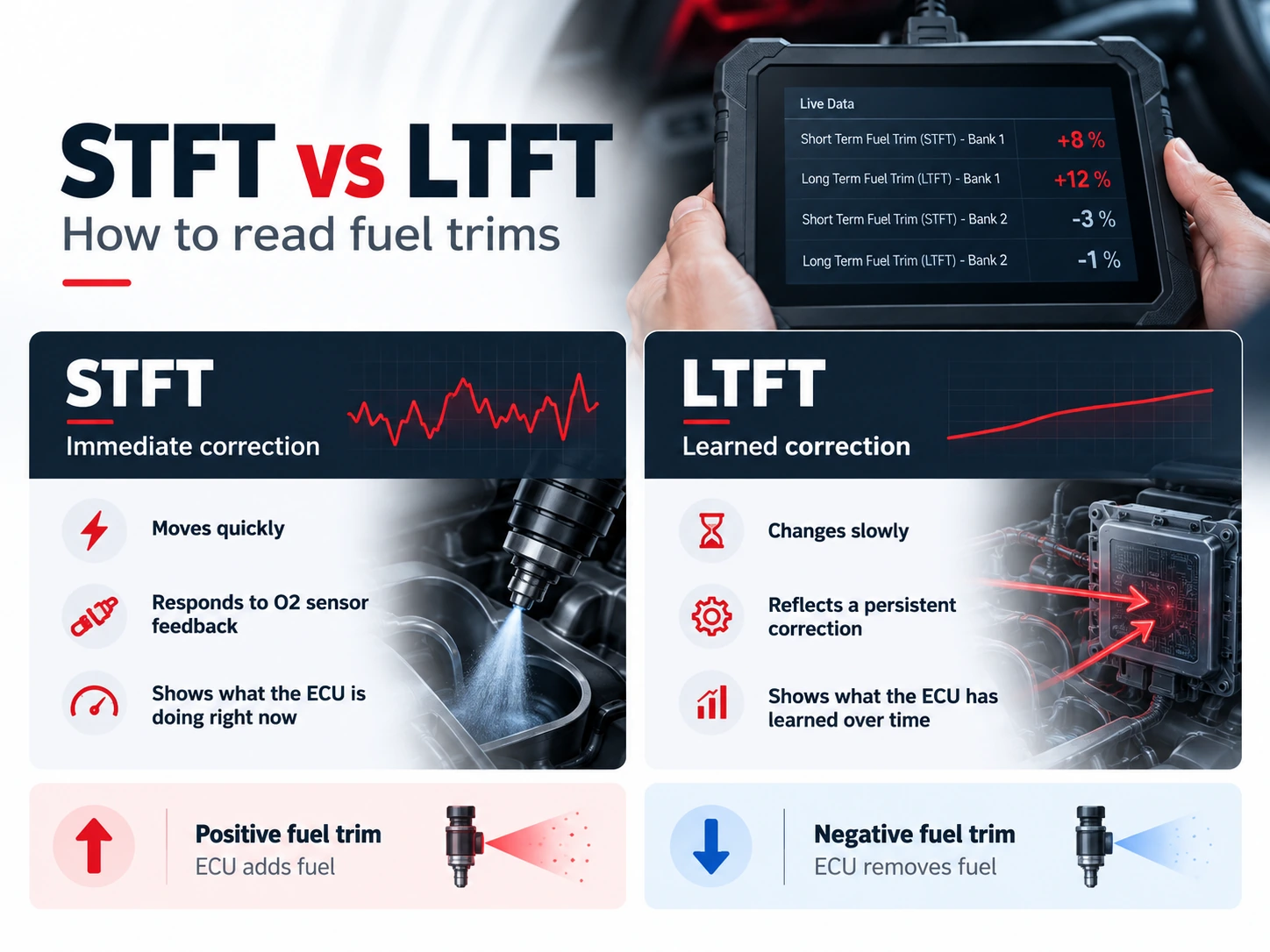
A fuel trim value close to 0% means little correction is required. Positive values mean the ECU is adding fuel. Negative values mean the ECU is removing fuel.
On vehicles that support the standard OBD2 parameters, fuel trims are available through these live-data PIDs:
- PID 06 – Short-Term Fuel Trim, Bank 1
- PID 07 – Long-Term Fuel Trim, Bank 1
- PID 08 – Short-Term Fuel Trim, Bank 2
- PID 09 – Long-Term Fuel Trim, Bank 2
These values are especially useful on gasoline engines operating in closed-loop fuel control.
STFT vs LTFT – What Is the Difference?
Short-Term Fuel Trim (STFT)
STFT is the ECU’s immediate correction. It reacts quickly to oxygen-sensor feedback and normally moves up and down while the engine is running.
For example:
- STFT +8% = the ECU is currently adding about 8% fuel compared with its base calculation
- STFT -6% = the ECU is currently removing about 6% fuel
STFT changing continuously is normal. The important question is whether it stays biased strongly positive or negative.
Long-Term Fuel Trim (LTFT)
LTFT is the learned correction the ECU has built up over time. It changes more slowly than STFT and reflects a correction that has been needed consistently.
For example, if LTFT is +12%, the ECU has learned that it generally needs to add fuel in that operating range.
LTFT is often more useful than one instantaneous STFT reading because it shows the direction in which the engine has been adapting.
What Do Positive and Negative Fuel Trims Mean?
| Fuel trim direction | What the ECU is doing | Typical diagnostic direction |
|---|---|---|
| Positive | Adding fuel | The ECU is correcting for a mixture it sees as lean |
| Negative | Removing fuel | The ECU is correcting for a mixture it sees as rich |
| Near 0% | Little correction | The base fuel calculation is close to the required mixture |
A positive fuel trim does not automatically mean that an oxygen sensor is faulty. It tells you what the ECU is correcting. The job is to find out why that correction is needed.
What Fuel Trim Values Are Normal?
There is no single universal pass/fail number for every engine, but fuel trims that stay close to 0% under stable operating conditions are generally a good sign.
As a practical diagnostic guide:
- Around 0% to ±5%: usually only a small correction
- Persistent correction around ±10%: worth investigating in context
- Persistent correction around ±15–20% or more: a strong sign that the ECU is compensating for a meaningful mixture problem
Do not diagnose from one number alone. Compare STFT and LTFT together, compare banks where applicable and watch how the values change between idle and higher RPM.
How to Read STFT and LTFT Together
For a quick diagnostic view, technicians often look at STFT and LTFT together.
Example:
- STFT +4% and LTFT +9% = approximately +13% combined correction at that moment
- STFT -3% and LTFT -7% = approximately -10% combined correction
This combined value is useful for pattern recognition, but it is not a universal manufacturer specification. ECU fuel-control strategies and adaptation cells differ between vehicles.
Bank 1 vs Bank 2
Bank 1 is the side of the engine that contains cylinder 1. Bank 2 is the opposite cylinder bank on engines that use two banks.
Comparing banks is extremely useful:
- Both banks strongly positive: look first for a problem affecting the whole engine, such as unmetered air, MAF error or low fuel supply
- Only one bank strongly positive: look for a bank-specific intake leak, injector issue, exhaust leak or sensor-related problem
- Both banks strongly negative: look for a rich condition affecting the whole engine, such as excessive fuel pressure, incorrect airflow calculation or purge-related fuel vapour
On an inline engine there is normally only one cylinder bank.
How to Diagnose a Problem Using Fuel Trims
1. Warm the Engine
Read fuel trims with the engine at normal operating temperature and, when applicable, in closed-loop fuel control. STFT may report 0% while the system is in open loop, so a cold-engine reading can be misleading.
2. Record Fuel Trims at Idle
Note STFT and LTFT for each supported bank. Do not focus on one fast STFT movement; look at the general direction and the learned LTFT value.
3. Compare the Values at Approximately 2,500 RPM
Hold the engine at a steady higher RPM with no heavy load and compare the fuel trims with the idle readings.
This comparison can reveal useful patterns:
| Pattern | Likely diagnostic direction |
|---|---|
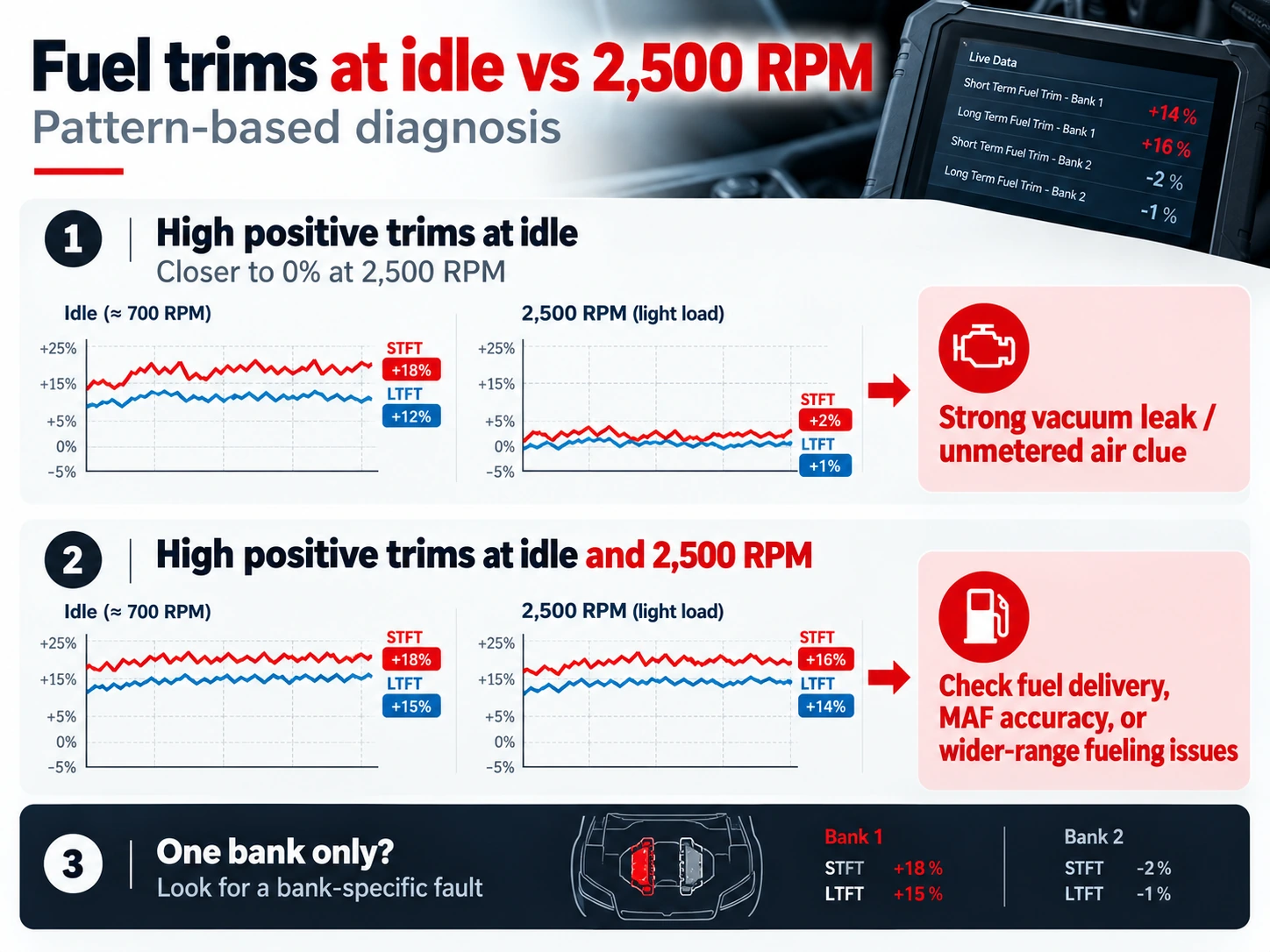
| High positive trims at idle, much closer to 0% at 2,500 rpm | Vacuum leak or other unmetered-air leak is a strong possibility |
| High positive trims at idle and 2,500 rpm | Check fuel delivery, MAF accuracy and other faults affecting the full operating range |
| High positive trim on one bank only | Check bank-specific intake leaks, injectors, exhaust leaks and sensor signals |
| Strong negative trims on both banks | Check for excessive fuel delivery, incorrect airflow calculation, leaking injectors or purge-related enrichment |
4. Compare Both Banks
If Bank 1 and Bank 2 behave differently, use that difference to narrow the fault. A problem shared by both banks is more likely to be upstream of the point where the intake or fuel system separates.
5. Compare Fuel Trims With Other Live Data
Fuel trims become much more powerful when compared with other live-data values, including:
- MAF airflow
- MAP pressure
- Oxygen or air-fuel ratio sensor data
- Engine coolant temperature
- Fuel pressure where supported
- Engine RPM and load
Do not replace a sensor simply because the fuel trims are abnormal. Use the additional data to confirm whether the sensor is reporting the problem or causing it.
Common Fuel Trim Patterns
Positive Fuel Trims Mainly at Idle
This pattern often points toward unmetered air. At idle, a vacuum leak can represent a large percentage of the engine’s total airflow. As RPM and commanded airflow increase, the same leak becomes proportionally less important and the trims may move closer to 0%.
Positive Fuel Trims at Idle and Higher RPM
If the ECU keeps adding fuel across a wider operating range, investigate causes that are not limited to manifold vacuum. Possibilities include low fuel pressure, restricted fuel delivery, MAF under-reporting or a larger air-measurement error.
Negative Fuel Trims
Negative trims mean the ECU is removing fuel because it sees the mixture as rich. Causes can include excessive fuel pressure, a leaking injector, incorrect MAF calculation, purge-system problems or other sources of excess fuel.
One Bank Different From the Other
A large bank-to-bank difference is valuable diagnostic information. Concentrate on components that can affect only that side of the engine before replacing parts shared by both banks.
Fuel Trims and Lean/Rich Fault Codes
Fuel trims are especially useful when diagnosing these fault-code families:
- P0170 – Fuel Trim Malfunction (Bank 1)
- P0171 – System Too Lean (Bank 1)
- P0172 – System Too Rich (Bank 1)
- P0173 – Fuel Trim Malfunction (Bank 2)
- P0174 – System Too Lean (Bank 2)
- P0175 – System Too Rich (Bank 2)
A lean or rich code tells you the ECU reached a condition it could not correct normally. Fuel trims help show how the correction developed and whether the fault affects one bank, both banks, idle only or a wider operating range.
Related Diagnostic Guides
- Car Runs Lean – Causes, Diagnosis and How to Fix
- Car Runs Rich – Causes, Diagnosis and How to Fix
- OBD2 Fault Code Library
What Scanner Do You Need to Read Fuel Trims?
You need an OBD2 scanner that can display live data. At minimum, it should show STFT and LTFT for the supported banks. For more useful diagnosis, look for a scanner that also displays MAF, MAP, oxygen or air-fuel ratio sensor data and fuel pressure where the vehicle supports it.
A basic code reader can identify a lean or rich fault code, but live-data capability is what allows you to see how the ECU is correcting the mixture in real time.
Common Mistakes When Reading Fuel Trims
- Judging the engine from one momentary STFT value
- Reading trims before the engine reaches normal operating temperature
- Ignoring whether the fuel system is in open loop or closed loop
- Looking at only one bank on a two-bank engine
- Assuming positive fuel trim automatically means a bad oxygen sensor
- Ignoring how the trims change between idle and higher RPM
Fuel Trim FAQ
Does positive fuel trim mean lean?
Positive fuel trim means the ECU is adding fuel because its feedback indicates that more fuel is needed. In diagnosis, this usually points toward a lean correction.
Does negative fuel trim mean rich?
Yes. Negative fuel trim means the ECU is removing fuel because it sees more fuel than needed for the commanded mixture.
Should STFT always stay at 0%?
No. STFT normally moves above and below 0% as the ECU makes rapid corrections. A persistent bias in one direction is more important than normal small movement.
Which is more important, STFT or LTFT?
Both matter. STFT shows the immediate correction, while LTFT shows what the ECU has learned over time. Reading them together gives a much clearer diagnostic picture.
Can a vacuum leak cause high positive fuel trims?
Yes. Unmetered air can make the mixture lean, causing the ECU to add fuel. A common clue is that positive trims are highest at idle and improve when RPM is increased.
Can a bad MAF sensor affect fuel trims?
Yes. If the MAF sensor reports too little or too much airflow, the ECU’s base fuel calculation can be wrong and fuel trims will compensate in the opposite direction.